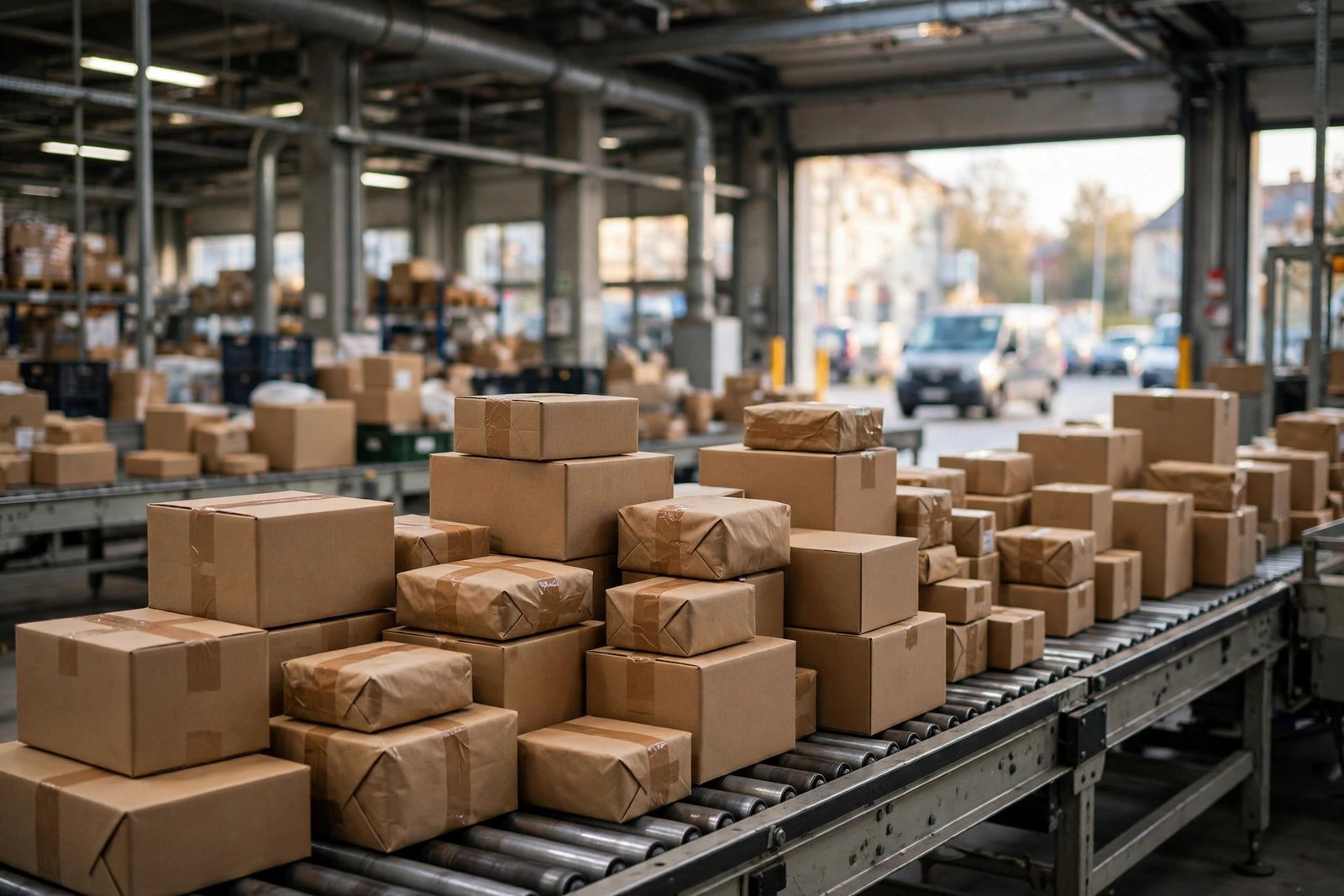
Online shopping into Europe got a little more expensive on 1 November 2026. The European Union has started a new €2 handling fee on parcels sent from outside the bloc directly to shoppers. The charge lands just weeks before Black Friday, Cyber Monday and the Christmas rush, when millions of people order gifts from China, the United States and other countries.
The fee applies across all 27 EU member states, including orders through large platforms such as Temu, Shein, AliExpress and Amazon. The key question is simple: who pays, and how much does it add to an order?
How the €2 fee works
The new charge is a handling fee, not a tax on the value of the goods. It is set at €2 per item, but "item" does not mean each single piece in a parcel. It means each type of product on the customs declaration. Ten identical T-shirts in one parcel count as one item, so the fee is €2. A parcel with two hats and ten T-shirts has two item types, so the fee is €4.
The fee has no value limit. That differs from the €3 customs duty introduced on 1 July 2026, which only applies to parcels worth €150 or less. From 1 November, a low-value parcel can carry both charges: €3 of duty plus €2 of handling fee per item type, before VAT. A basket with five different products worth under €150 could pick up €25 before VAT.
There is one more detail sellers should know. The handling fee is not refunded if the goods are returned. Once the parcel has been declared and released, the fee stays paid, even if the shopper sends the item back.
Why Brussels acted
The EU says customs offices are drowning in small parcels. Around 6 billion small parcels from online sellers entered the EU in 2025, and about 90 percent came from China. Each parcel must be checked, and that work costs money.
Officials also point to safety. A test by Portugal's consumer group DECO found that 69 percent of 162 products bought from Temu and Shein did not meet the rules that applied to them. The EU says the fee helps pay for the checks that catch such goods.
The fee is part of a wider customs reform. The EU ended the old €150 duty-free exemption on 1 July 2026 and plans a central customs data hub for 2028. The €3 duty is only temporary, running until 1 July 2028. The €2 handling fee is meant to be permanent, although the EU must review its amount every two years.
Who actually pays?
Officially, the shopper does not owe the fee. The declarant pays it: the online platform, the seller, or their representative, often through the Import One Stop Shop (IOSS) system used for EU VAT.
But that does not mean shoppers will never feel it. Sellers and platforms are free to raise their prices to cover the cost, as long as the full price is shown before the order is placed. The European Consumer Organisation, known as BEUC, has warned that some platforms may try to pass the new costs on to shoppers at the last steps of checkout. Shoppers should therefore watch the final price at checkout, not just the price shown on the product page.
What sellers should do now
For sellers who ship to Europe, the maths has changed. Orders with many different product types now cost more in fees than orders with one type, even at the same total value. Each declaration line adds €2, so grouping identical products on one line, where the rules allow it, keeps the fee down.
Sellers should also look at their prices. A €2 or €4 fee may seem small, but on a low-priced item it can wipe out the profit. Some may raise prices, some may stop shipping single cheap items to the EU, and some may ship in bulk to EU warehouses instead. From 1 November, product identifiers also became mandatory on customs declarations for low-value parcels.
For shoppers, the advice is simpler. Compare the final checkout price, not the headline price. Buying several identical items together is cheaper in fees than buying many different items in one order.
What happens next
How much of the fee reaches shoppers will become clear in the next few weeks, as platforms update prices for Black Friday on 27 November and Cyber Monday on 30 November. If platforms absorb the cost, shoppers may notice little change. If they pass it on, the age of the ultra-cheap single parcel may be ending.
Sources
- Malay Mail (AFP) — "€2 here, €3 there: EU adds another charge to cheap online shopping", 1 November 2026 — malaymail.com
- Channel News Asia (AFP) — "EU's new levy on parcels kicks in", 1 November 2026 — channelnewsasia.com
- Austrian Press — "New EU Fee Takes Effect: Parcels From China Become More Expensive", 2 November 2026 — austrianpress.com
- Eurotoday — "EU Implements €2 Parcel Fee on Non-European Online Orders", 1 November 2026 — eurotoday.org
- LHR Rechtsanwälte — "EU handling fee: EUR 2 per item from 1 Nov 2026" (European Commission guidance of 5 October 2026; Regulation (EU) 2026/2108; Delegated Regulation C(2026) 6694) — lhr-law.de
- DutyAhead — "EU €3 duty per item: how items are counted" (European Commission guidance; Irish Revenue) — dutyahead.com
- Sortiraparis — "Shein, Temu and AliExpress packages: an extra €2 fee on small parcels from November 1, 2026", 28 October 2026 — sortiraparis.com