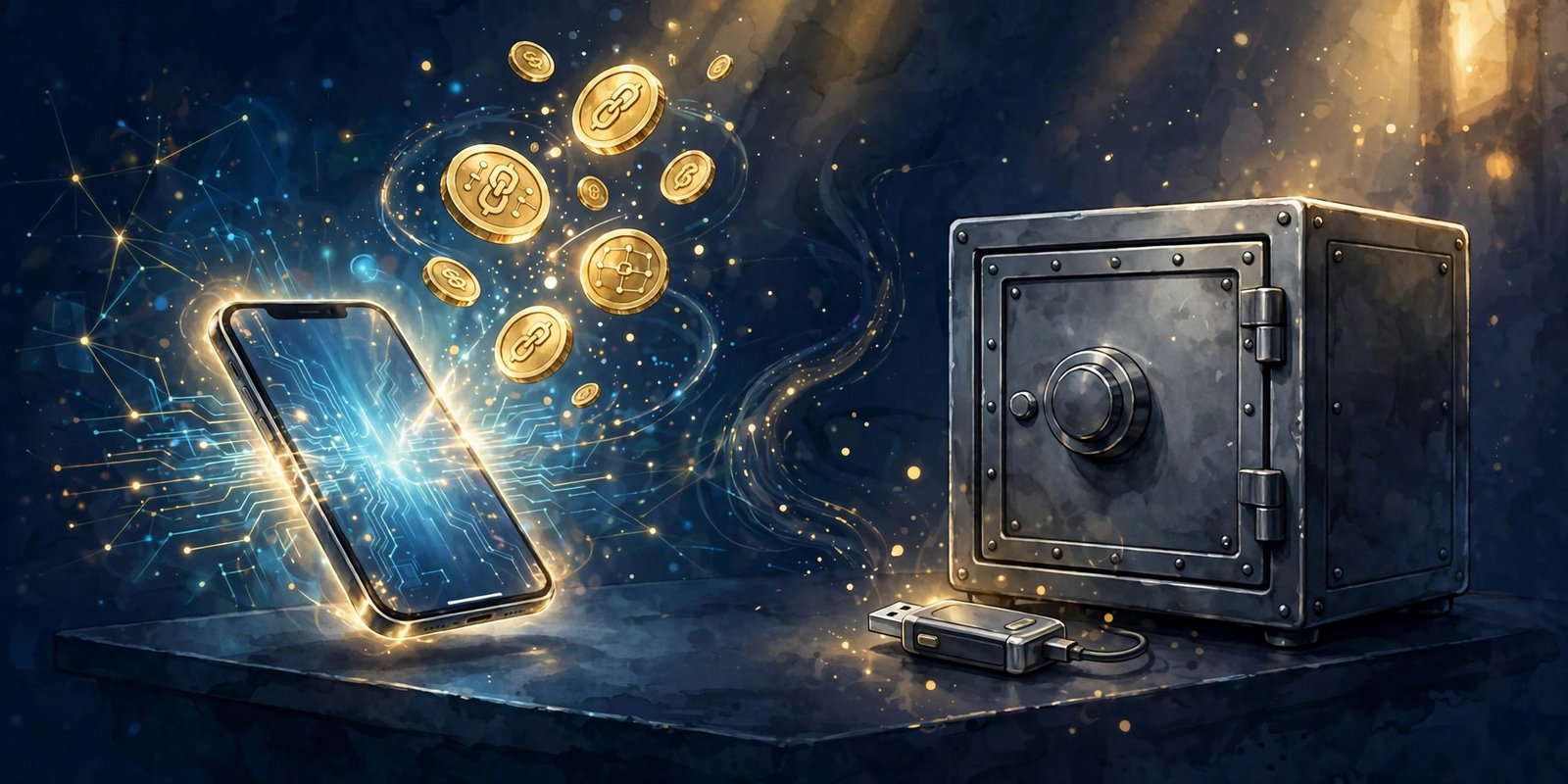
Your Coins Are Not in the Wallet
This sounds strange at first, but it is the most important thing to understand: a crypto wallet does not hold your coins. Your coins live on the blockchain, a public record shared across thousands of computers. What the wallet holds is your private key — the secret password that proves the coins are yours and lets you move them.
Lose the key, and you lose the coins. Nobody — not the exchange, not the police, not the government — can get them back for you. This is why choosing the right wallet, and keeping its key safe, is the single biggest security decision a crypto owner makes.
Wallets come in two broad families: hot wallets, which are connected to the internet, and cold wallets, which are kept offline. Each has strengths and weak spots. This guide explains both in plain language, so you can pick the right one for your money.
What Is a Hot Wallet?
A hot wallet is any crypto wallet that is connected to the internet. If you can send or receive coins with a few taps on your phone, it is a hot wallet.
Common types of hot wallets:
- Mobile apps — wallet apps on your phone (for example, apps that support many coins at once).
- Desktop wallets — programs installed on your computer.
- Browser wallets — small add-ons inside your web browser, often used with online crypto apps.
- Exchange accounts — when you keep coins on a trading platform like Binance or Coinbase, they sit in the platform's wallet, which is online around the clock.
Strengths of hot wallets
- Fast and easy. Sending coins takes seconds — scan a code, tap confirm, done. Perfect for everyday use.
- Free to start. Most hot wallets cost nothing to download and set up.
- Good for trading. If you buy and sell often, your coins need to be online and ready.
- Helpful features. Many apps show prices, let you swap one coin for another, and connect to other crypto services.
Weak spots of hot wallets
- Hackers can reach them. Anything connected to the internet can be attacked. Phones get stolen, computers get viruses, and fake wallet apps exist to steal keys.
- Exchange risk. Coins left on an exchange are controlled by the exchange, not you. If the exchange is hacked, freezes accounts, or collapses, your coins may be locked or lost. History has examples of all three.
- Phishing. Fake websites and messages pretend to be your wallet and ask for your secret words. One mistake can empty your balance.
What Is a Cold Wallet?
A cold wallet is a wallet that stays offline. Its private key never touches the internet, so online hackers cannot reach it.
Common types of cold wallets:
- Hardware wallets — small devices, about the size of a USB stick, made by companies like Ledger and Trezor. You plug one into your computer only when you want to send coins, and unplug it after.
- Paper wallets — your secret key printed (or written) on paper and stored somewhere safe, like a locked drawer.
- Air-gapped devices — old phones or computers that are never connected to the internet, used only to sign transactions.
Strengths of cold wallets
- Much harder to hack. There is no internet path to the key. This is the gold standard for long-term storage.
- You hold the key yourself. No company stands between you and your coins — no account to freeze, no platform to collapse.
Weak spots of cold wallets
- They cost money. A good hardware wallet costs roughly the price of a dinner out — worth it for serious savings, but an expense.
- Slower to use. Every transfer means finding the device, plugging it in, and confirming on its small screen. Bad for daily spending.
- Paper can be destroyed. Fire, water, or a cleaning day can wipe out a paper wallet. And "cold" only works if the key is truly never typed into an online device.
- You are fully responsible. Break or lose the device AND its backup, and the coins are gone forever — there is no "forgot password" button.
Hot vs Cold: Side by Side
| Hot wallet | Cold wallet | |
|---|---|---|
| Internet connection | Always online | Offline (key never touches the net) |
| Hack risk | Higher — reachable online | Much lower — no online path to the key |
| Speed | Seconds | Minutes — plug in, confirm, unplug |
| Cost | Usually free | Device costs money; paper is free but fragile |
| Best for | Small amounts, daily use, active trading | Large amounts, long-term holding |
| Biggest danger | Phishing, hacks, exchange problems | Losing the device or its backup |
Which One Should You Use? The Simple Rule
Most experienced crypto owners use both — like a wallet in your pocket and a safe at home:
- Hot wallet = your pocket. Keep small amounts here — what you might spend or trade this week. Easy access matters more than maximum security.
- Cold wallet = your safe. Keep the savings here — the coins you do not plan to touch for months or years. Security matters more than convenience.
A practical starting point: if losing the amount would genuinely hurt you, it belongs in cold storage. If it is pocket money for the crypto world, a hot wallet is fine.
Protecting Your Keys: Habits That Matter More Than the Wallet
The fanciest hardware wallet cannot save you from bad habits. These rules apply to every wallet:
- Guard your seed phrase. When you create a wallet, it shows you 12 or 24 secret words — the "seed phrase." Anyone with these words owns your coins. Write them on paper, store copies in two separate safe places, and never photograph them, email them, or type them into any website.
- Never share your private key. No real support agent, exchange, or wallet company will ever ask for it. Anyone who asks is a thief.
- Buy hardware wallets new, from the maker. A used or "discounted" device from a stranger may be tampered with.
- Check the address twice. Before sending coins, compare the first and last few characters of the destination address on your screen. Some viruses silently swap addresses.
- Start with a tiny test. Sending to a new address? Send a small amount first. When it arrives, send the rest.
- Keep software updated. Wallet apps and hardware devices get security fixes — install them, but only from the official website or app store.
- Use strong, separate passwords. Your wallet app password and exchange password should be long and unique. Turn on two-factor authentication (2FA) wherever it is offered — ideally an authenticator app, not SMS.
- Beware of "support" on social media. Scammers search for people asking wallet questions and offer "help" that ends in theft.
Red Flags: When Something Is a Scam
- Promises of guaranteed or doubled returns — "send 1 coin, get 2 back."
- Urgency and pressure — "your wallet will be locked in 10 minutes unless you act."
- Requests for your seed phrase or private key, for any reason.
- Download links sent by strangers or "support agents" in chat apps.
- Giveaways asking you to "verify" your wallet by sending coins first.
When in doubt, stop and ask a trusted, knowledgeable friend — or simply do nothing. In crypto, doing nothing is almost always safer than acting fast.
Frequently Asked Questions
Can I keep my coins on an exchange forever?
You can, but most security experts advise against keeping large amounts there. On an exchange you do not hold the private key — you hold an IOU. For long-term savings, move coins to a wallet where you control the key.
What happens if I lose my hardware wallet?
Nothing, as long as you have your seed phrase. Buy a new device (or use a compatible wallet app), enter the 24 words, and your coins reappear. The device is replaceable; the seed phrase is not.
Are paper wallets still a good idea?
They work, but they are fragile and easy to mess up (a printer with memory, a photo in the cloud, a spilled glass of water). A hardware wallet is safer for most people. If you use paper, generate the key fully offline and store it like cash.
Can a cold wallet be hacked?
Remote hacking is extremely difficult because the key is offline. The realistic risks are physical theft, tampered devices, and — most commonly — the owner being tricked into revealing the seed phrase. Cold storage protects against hackers, not against scams.
Do I need a separate wallet for each coin?
Usually not. Most modern wallets support many coins in one app or device. Just check that your wallet supports the specific coin before sending anything to it — sending a coin to an incompatible address can lose it.
Is crypto in a wallet insured like bank money?
No. Bank deposits in many countries are protected by government insurance up to a limit. Crypto has no such safety net. If your coins are stolen or lost, there is no refund process — which is exactly why wallet security matters so much.
The Bottom Line
Hot wallets are for spending, cold wallets are for saving. Keep small, active amounts online where they are easy to reach, and move serious money offline where hackers cannot follow. Above all, protect your seed phrase like the key to your house — because in crypto, it is. This article is educational, not financial advice: do your own research, and never invest money you cannot afford to lose.