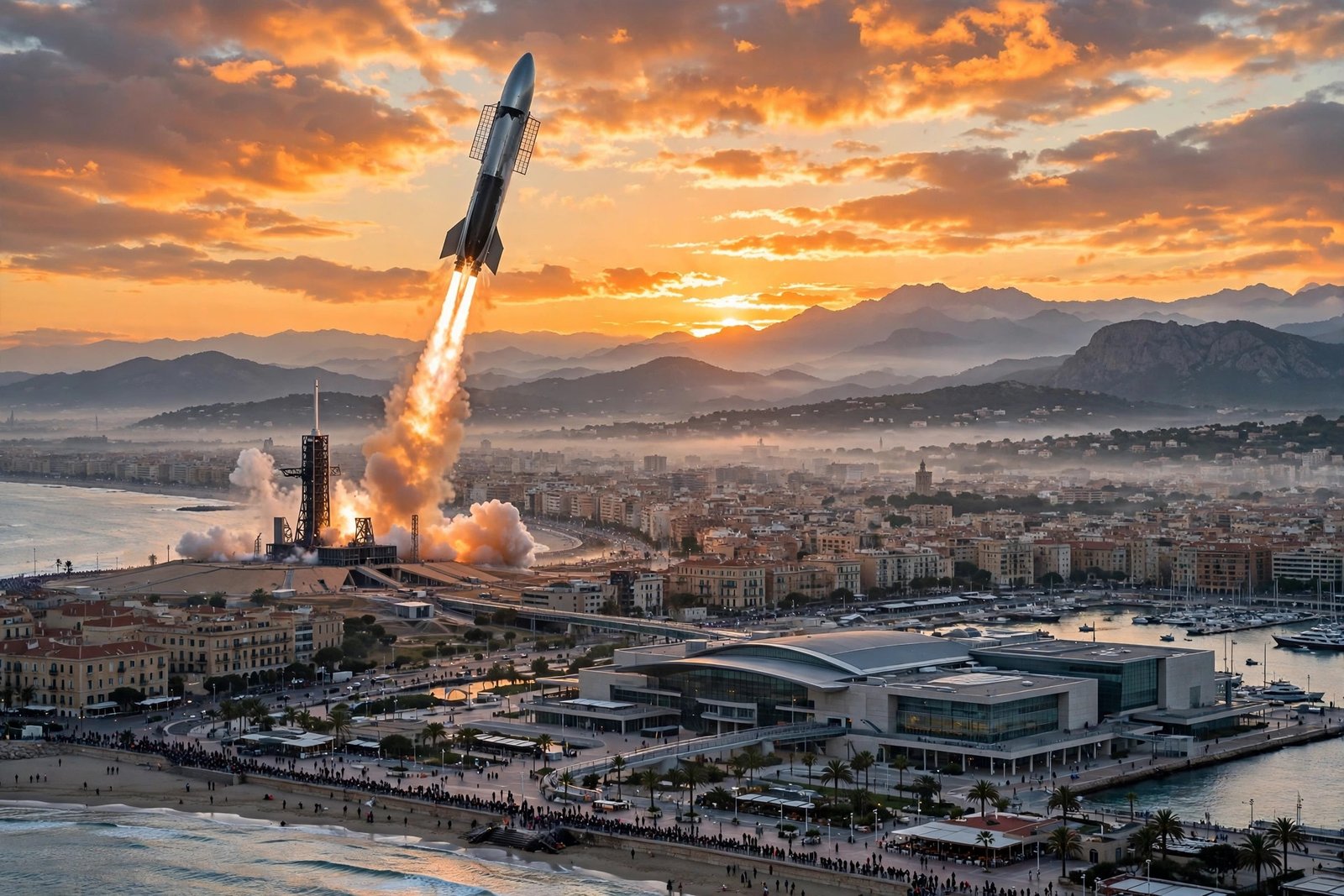
In the first week of October 2026, more than 10,000 people flew into Antalya, a resort city on Türkiye's Mediterranean coast. They were scientists, engineers, company bosses, government ministers and students from more than 100 countries. They had all come for the same event: the 77th International Astronautical Congress, or IAC 2026.
It was the biggest space gathering ever held. Organisers received 8,330 research abstracts from 108 countries, a record in the congress's long history, with more than 4,000 presentations planned across over 180 technical sessions. The theme of the week was simple: "The World Needs More Space."
Why did this particular congress break every record? The answer says a lot about where the space industry is heading.
The biggest space meeting ever
The International Astronautical Congress is organised every year by the International Astronautical Federation. For more than 75 years it has been the main annual meeting point for the global space community: space agencies, private companies, researchers, policymakers and students.
The 2026 edition was the first to be held in Türkiye, hosted by the Turkish Space Agency and co-hosted by SAHA Istanbul, the country's large defence and aerospace industry cluster. Host nation Türkiye led the submissions with 1,810 abstracts, the highest number ever submitted by a single country in the congress's history. Of the 8,330 abstracts, 4,077 were accepted directly and 542 were placed on a waiting list.
Why this year, and why Türkiye
Record numbers at a space congress do not happen by accident. They reflect something real: space is no longer a club for two superpowers and a handful of rich countries.
The submission list shows how the map is changing. After Türkiye, Azerbaijan sent 814 abstracts, the United States 615 and China 599, with strong showings from Italy, the United Kingdom, Germany, India and Japan. But the growth also came from places that barely registered a decade ago: Peru submitted 287 abstracts and Mexico 234.
For Türkiye, hosting the congress was a statement of intent: a way to connect its growing defence and aerospace industry, represented by SAHA Istanbul's 1,300-plus companies and 30 universities, with global investors and research networks.
The rocket revolution behind the records
The surge in interest has a concrete cause, and it was visible in the skies over Texas just a week before the congress opened. On September 28, 2026, SpaceX flew the 14th test flight of Starship, the largest rocket ever built. It was the vehicle's first orbital flight.
Starship reached an orbit of about 275 kilometres and deployed 26 new Starlink V3 satellites, the first commercial payload the rocket has ever carried. Each V3 satellite is rated at about one terabit per second of capacity, a large jump over earlier models, and a sign of how important Starship is to scaling SpaceX's satellite internet business.
The flight was not perfect. One of the six Raptor engines on the upper stage suffered an anomaly, and controllers cut the planned six-orbit, ten-hour mission short. The Super Heavy booster made a controlled splashdown in the Gulf of Mexico, and the upper stage reentered over the Pacific. Analysts called it an important step toward full reusability that also showed how much still has to go right.
There was a quieter detail engineers noticed: the heat shield flew with thermal protection tiles refurbished from an earlier vehicle. Reusing tiles across flights matters, because inspecting and replacing thousands of them has long been one of the biggest obstacles to flying a reusable spacecraft often.
This is the "rocket revolution" that the United Nations' World Space Week, held October 4 to 10, chose as its 2026 theme. Reusable rockets, led by SpaceX's Falcon 9, have changed the economics of getting to space. SpaceX carried out 167 launches in 2025 out of 324 worldwide, more than half of all launches on Earth, and its launch cadence grew by more than 400 percent between 2021 and 2025.
Hourly flights? The promise and the doubts
SpaceX's chief executive, Elon Musk, is not shy about where this leads. On September 27, 2026, he wrote on X that Starship is "2 to 3 years away from hourly flights." A month earlier he had said the company was targeting 30 Starship launches per day by 2030, with a long-term goal of 10,000 launches a year.
The company is acting on those ambitions. In mid-October 2026, SpaceX asked federal regulators for permission to raise its Starship launch limit at Starbase in South Texas from 25 a year to as many as 456, with up to 912 landings, since both stages of the rocket are designed to return. The Federal Aviation Administration announced on October 14 that it would prepare a full environmental impact statement and open a public scoping period, the first step in a long review.
The next test flights are already being prepared. Flight 15 is targeting November 2026, with the goal of catching both the booster and the ship with the launch tower, and Flight 16 could become the first Starship launch from Florida's Launch Complex 39A in December. Both dates remain provisional.
But independent analysts urge caution. They point out that the goal is not just full reusability but rapid reusability: how fast a flown vehicle can be inspected and reflown. In their words, that is one of the most important unanswered questions.
The history of technology is full of bold timelines that slipped. What is harder to argue with is the direction of travel: launches are getting cheaper and more frequent, and more countries and companies are getting involved.
What this means for ordinary people
It is easy to read about record-breaking space congresses and hourly rocket flights as news for specialists. But the reason "The World Needs More Space" works as a theme is that space technology already touches daily life in ways most people never notice.
Cheaper launches mean more satellites, and more satellites mean better services on the ground. Weather forecasts, which save lives before storms and floods, depend on satellite data. Navigation apps, banking networks and power grids rely on precise signals from navigation satellites. Satellite internet reaches rural areas and ships that fibre cables will never reach. Farmers use satellite images to plan planting; climate scientists track ice loss and emissions from orbit.
When launch costs fall, all of these get cheaper and better. A university in Peru or Azerbaijan that could never afford a satellite program ten years ago can now build a small one.
There is also a simpler human angle. For a young researcher in Istanbul, Lahore or Nairobi, seeing their country host the world's biggest space meeting changes what feels possible. Industries are built by people who were once inspired at events exactly like this one.
The hard questions
A fair account of the new space age has to include the concerns, and they were not absent from the conversation in Antalya.
More launches mean more satellites, and more satellites mean more crowded orbits. Space debris is already a real problem: dead satellites and fragments travel at enormous speeds and can destroy working spacecraft. International rules for avoiding collisions have not kept up with the pace of launches.
Rockets also have an environmental cost. Launches release gases and particles into the upper atmosphere, and the effect of hundreds or thousands of launches a year is not fully understood. That is one reason the FAA's environmental review of SpaceX's expansion plans matters: the technology is moving faster than the science of its impact.
And there is the question of who benefits. If a handful of companies control the cheapest rides to orbit and the largest satellite networks, the new space economy could concentrate power rather than spread it. The record participation from emerging countries is encouraging, but participation in a congress is not the same as ownership of the infrastructure.
Why Antalya mattered
When the delegates left Antalya, they took home more than a record attendance figure. The 2026 congress captured a moment when the space industry stopped being a niche and became something closer to a normal, global industry: crowded, competitive, commercial, and full of newcomers.
Reusable rockets made space cheaper. Cheaper space brought in new countries and new companies. New countries and new companies filled the halls in Antalya. That chain of cause and effect is the real story of IAC 2026, and it is still unfolding.
Whether Starship flies every hour by 2029 or takes far longer, the direction is set. The sky is getting busier, the map of who goes there is getting wider, and a record-breaking week on the Turkish coast showed the world paying attention.
Frequently asked questions
What is the International Astronautical Congress?
It is the world's largest annual space meeting, organised by the International Astronautical Federation. Space agencies, private companies, scientists, engineers and policymakers gather each year to present research and discuss policy. It has run for more than 75 years.
Where and when was IAC 2026 held?
The 77th congress took place from October 5 to 9, 2026, at the NEST Convention Center in Antalya, Türkiye, the first time Türkiye hosted the event. The host was the Turkish Space Agency, co-hosted by SAHA Istanbul.
Why did IAC 2026 break records?
Organisers received 8,330 research abstracts from 108 countries and expected more than 10,000 participants from over 100 countries, both all-time highs. The growth reflects how fast space activity is spreading to new countries, universities and private companies.
What was special about Starship Flight 14?
On September 28, 2026, Starship completed its first orbital flight, reaching about 275 kilometres and deploying 26 Starlink V3 satellites, its first commercial payload. An engine anomaly cut the mission short, but it was widely seen as a major milestone toward a fully reusable giant rocket.
Are hourly rocket flights realistic?
Elon Musk said in September 2026 that Starship is two to three years away from hourly flights, with a goal of 30 launches a day by 2030. Analysts are more cautious: the real challenge is rapid reusability, or how fast a flown vehicle can be inspected and reflown. The timeline is uncertain, but launches are clearly getting more frequent.
How does cheaper space travel affect ordinary people?
Cheaper launches mean more satellites, which improve weather forecasting, navigation, satellite internet, farming, disaster response and climate monitoring. Lower costs also let universities and companies in more countries run their own space programs.